
How to Apply the PDCA Cycle to Optimize Business Routines
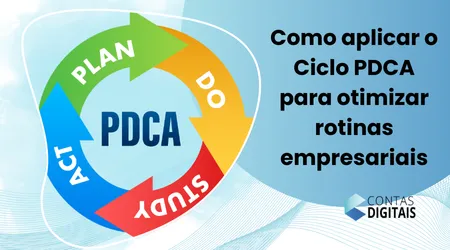
How to Apply the PDCA Cycle? The business world is dynamic and requires constant adaptation to maintain competitiveness.
In this context, the PDCA Cycle emerges as a practical and efficient methodology to optimize routines, reduce waste and achieve consistent results.
Originated in Japan and popularized by W.
Edwards Deming, this model structured in four steps (Plan, Do, Check and Act) offers a clear path for companies looking to improve processes without losing strategic focus.
On the other hand, applying the PDCA Cycle It's not just a matter of following a mechanical script.
It demands creativity, critical analysis and a close look at the particularities of each business.
Thus, instead of being just a management tool, it becomes a mindset that encourages continuous evolution, something essential in a market where stagnation can be costly.
So in this article, we will explore how the PDCA Cycle can be implemented intelligently to transform business routines.
From strategic planning to fault correction.
Each step will be detailed with practical examples and insights that go beyond the obvious, showing how this methodology can be the key to sustainable success.
1. Plan: The Foundation for Success with the PDCA Cycle
First of all, planning is the heart of PDCA Cycle. Without a solid foundation, any attempt at optimization is doomed to failure.
At this stage, the company must identify specific problems in current routines, define clear objectives and draw up a detailed action plan.
For example, imagine a sales team that is facing low conversion.
In this sense, the first step is to analyze data, such as closing rates and customer response time, to understand where the bottleneck is.
Furthermore, planning requires a forward-looking view.
See also: Family Business: How to Avoid Conflict and Maintain Success
It is not enough to simply correct what is wrong; it is necessary to anticipate challenges and align actions with the organization's long-term objectives.
In this way, the PDCA Cycle It differs from palliative solutions, as it encourages a systemic vision.
A logistics company, for example, may plan to reduce delivery time by 20%, but also predict how this will impact operating costs and customer satisfaction.
Finally, a useful tool at this stage is the use of key performance indicators (KPIs).
They help transform abstract goals into concrete numbers, making it easier to follow up later.
Thus, by structuring the plan clearly and with foundation, the company creates the ideal conditions for the next stages of the PDCA Cycle are successful.
| Planning Stage | Description | Practical Example |
|---|---|---|
| Problem Identification | Diagnose gaps or opportunities | Low customer retention |
| Goal Setting | Set clear and measurable goals | Increase retention by 15% in 6 months |
| Action Plan | Detail steps and those responsible | Train team and implement CRM |
2. Do: Putting the PDCA Cycle into Motion

With the plan in hand, it's time to act.
The execution stage of the PDCA Cycle It's where ideas come to life, but that doesn't mean acting impulsively.
On the contrary, implementation should be controlled, preferably on a small scale, to test the viability of the proposed solutions.
An example would be a factory that decides to adjust the layout of machines to improve production flow: before revamping the entire plant, it tests the change on a single line.
++ Free Online Courses to Develop Entrepreneurial Skills
Meanwhile, collecting data during execution is essential.
Without accurate information, the next phase of checking loses its effectiveness.
Therefore, it is recommended to document each step, recording variables such as time, cost and feedback from those involved.
This methodical approach transforms the PDCA Cycle in a scientific process, where assumptions give way to evidence.
Furthermore, successful execution depends on team engagement.
Leaders must ensure that everyone understands the purpose of the changes and is aligned with the goals.
So, the PDCA Cycle not only optimizes routines, but also strengthens organizational culture, promoting collaboration and a sense of purpose.
3. Check: Intelligent Assessment in the PDCA Cycle

After execution, it's time to evaluate the results.
The checking stage of the PDCA Cycle It is time to compare what was planned with what was done, identifying what worked and what needs adjustments.
Unlike a superficial analysis, this phase requires rigor and attention to detail.
For example, if a marketing campaign was launched to increase website traffic, it is necessary to check not only the number of hits, but also the quality of the visits and the impact on sales.
In this sense, the use of analytical tools is a differentiator.
Graphs, reports, and dashboards can reveal patterns that go unnoticed in a manual assessment.
In this way, the PDCA Cycle adapts to the digital age, enabling decisions based on data rather than intuition.
An e-commerce company, for example, may find that an aggressive discount attracted customers but reduced the profit margin beyond what is acceptable.
On the other hand, the check should not be seen as a final judgment.
It is, above all, a learning opportunity.
By identifying deviations, the company gains valuable insights to refine processes, making the PDCA Cycle a continuous improvement engine that goes beyond one-off fixes.
| Checking Metrics | Objective | Suggested Tool |
|---|---|---|
| Execution Time | Check process efficiency | Timer or management software |
| Operating Cost | Assess financial impact | Spreadsheets or ERP |
| Customer Satisfaction | Measure public perception | NPS Surveys |
4. Act: Consolidating Results with the PDCA Cycle
Finally, the action step closes the PDCA Cycle, but does not close the process.
Here, the company decides how to consolidate the gains obtained and correct any errors detected during the check.
If the initial test was successful, the solution can be expanded to other areas.
For example, if a new service policy reduced complaints at one branch, it can be standardized across the network.
However, taking action also means being prepared to start over.
If the results do not meet expectations, the PDCA Cycle encourages a return to planning, but now with more knowledge.
This flexibility is what makes the methodology so powerful: it turns mistakes into stepping stones to success.
An industry that tested a new raw material supplier and faced delays, for example, can adjust selection criteria and start a new cycle.
So, the PDCA Cycle is established as a cyclical and infinite process.
Each iteration refines business routines, eliminating inefficiencies and moving the organization closer to its strategic goals.
With this, it proves to be more than a tool; it is a management philosophy that combines pragmatism and innovation.
Benefits of the PDCA Cycle in Business Practice

In fact, the benefits of PDCA Cycle go beyond theory. First, it promotes efficiency by eliminating waste of time, resources and effort.
A company that applies the cycle in its supply chain, for example, can reduce excessive stocks without compromising production, balancing supply and demand accurately.
Furthermore, the methodology fosters organizational resilience.
In a scenario of economic crises or market changes, the PDCA Cycle allows for quick and informed adjustments, avoiding hasty reactions.
A retailer that sees a drop in in-person sales, for example, can use the cycle to test digital strategies and adapt to consumer behavior.
Finally, the impact on company culture is undeniable.
By involving teams in a structured improvement process, the PDCA Cycle encourages proactivity and shared responsibility.
In this way, it not only optimizes routines, but also builds an environment where innovation is part of everyday life.
Challenges and Solutions when Implementing the PDCA Cycle
Despite its benefits, implementing the PDCA Cycle is not free from obstacles.
Initially, resistance to change can be a problem.
Employees accustomed to fixed routines may view the cycle as a threat, which requires clear communication about its purposes and benefits.
Workshops and training are effective strategies to overcome this barrier.
Another challenge is the lack of consistency.
Many companies start the PDCA Cycle with enthusiasm, but abandon the process at the first difficulty.
To avoid this, it is crucial to assign responsibility for each step and establish realistic deadlines.
This way, the cycle remains alive and productive, generating tangible results.
Finally, the absence of reliable data can compromise the effectiveness of the method.
Without accurate information, decisions become fragile.
Investing in management systems and staff training to collect and interpret data is, therefore, an intelligent solution that enhances the PDCA Cycle.
Conclusion: The PDCA Cycle as a Competitive Differentiator
In short, the PDCA Cycle is a versatile methodology that transforms business routines by combining strategic planning, practical execution, rigorous evaluation and corrective action.
Unlike rigid approaches, it adapts to the needs of each organization, offering a clear path to efficiency and innovation.
Therefore, companies that want to stand out in a competitive market must consider the PDCA Cycle not as an option, but as a necessity.
Whether it's to reduce costs, improve quality or increase customer satisfaction, it provides a solid framework for achieving consistent results.
So, how about taking the first step?
Start by identifying a routine that needs adjustments and apply the PDCA Cycle.
With discipline and creativity, the results can surprise, consolidating your company as a reference in intelligent and sustainable management.
